Can a Solar Battery Handle Sudden Power Surges?
A solar battery can respond quickly when household electricity demand changes, but “power surge” can describe several different events. For home energy planning, the most relevant case is often a brief jump in appliance demand when equipment starts or several loads operate together. Whether a battery system can serve that moment depends on its specified power capabilities and the connected electrical setup. Battery capacity alone cannot answer the question. Homeowners need to understand the size, duration, and source of a demand spike before comparing it with a system’s documented output.

Read a Power Surge as a Short Electrical Event
Starting an Appliance Can Change Demand in an Instant
Household electricity use rarely rises in perfectly smooth steps. Some equipment changes its power demand as operating stages begin, while several appliances may also start close together. A heat pump can enter a new operating phase just as kitchen equipment or another electrical load becomes active. From the battery system’s perspective, the important information is the total power requested at that moment. This is measured in watts or kilowatts rather than kilowatt-hours. The distinction matters because a battery may contain plenty of stored energy for the next several hours, while the immediate question concerns how rapidly the system can deliver power. Checking documented output specifications therefore comes before estimating how long stored energy will last.
Peak Demand and Daily Energy Tell Different Stories
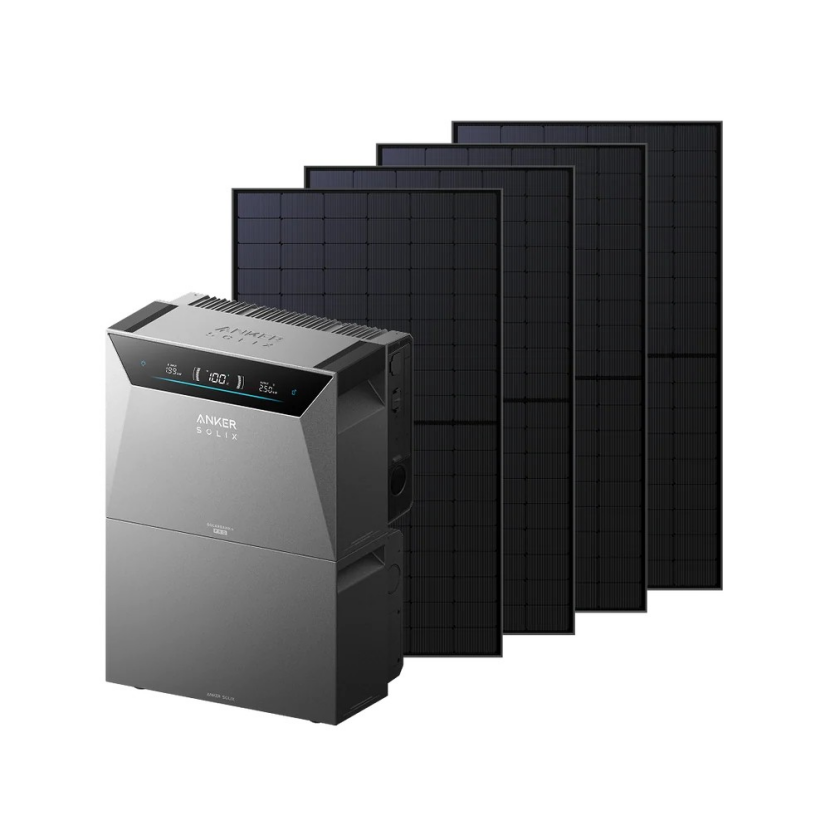
Consider two homes that each consume 10 kWh over a certain period. One may spread that electricity across many hours, while the other may concentrate several large loads into shorter windows. Their energy totals match, but their power profiles look very different. Sudden demand belongs to the second measurement: power at a particular moment. This is why a 5 kWh capacity figure should not be used to infer short-term output capability. The Anker SOLIX Solarbank 4 E5000 Pro, for example, has 5,000 Wh of capacity and a specified 2,500 W on-grid AC output. It also includes a built-in 2,500 W off-grid port. Those specifications describe different aspects of the system and should be read separately.
Duration Determines How Much Energy the Event Uses
A short burst of high power can have a surprisingly modest effect on total stored energy if it lasts only briefly. Energy equals power multiplied by time. A hypothetical 2 kW load maintained for three minutes uses 0.1 kWh because three minutes equals 0.05 hours. The same 2 kW load operating for one hour uses 2 kWh. This arithmetic explains why power surges and battery runtime are related but not interchangeable topics. The first asks whether the system can deliver the required power during the event. The second asks how much stored energy the event consumes. Separating those questions prevents capacity, output, and operating duration from being treated as though they were the same specification.
Plan the Home Around Changing Power Demand
A Load Timeline Reveals Where Peaks Actually Occur
Rather than listing every appliance in the house, create a timeline for periods when electricity demand becomes concentrated. Breakfast might combine cooking equipment with heating-related loads. Early evening could bring another combination of kitchen appliances, entertainment, and household equipment. Mark when these activities overlap and add their expected wattages. This produces a household load curve with visible peaks instead of one daily consumption number. Solarbank 4 E5000 Pro is designed with 2,500 W on-grid output for everyday household essentials, while its built-in off-grid port also provides 2,500 W. For homeowners evaluating systems, documented output ratings provide the relevant reference point when comparing the battery setup with these short periods of concentrated demand.
Smart Measurement Adds Context to Changing Loads
Actual household data can refine a load timeline because people do not always use appliances according to a fixed schedule. Solarbank 4 E5000 Pro works with Smart Meter Gen 2 for real-time monitoring. Its dual-circuit design monitors the main grid, while the second channel can provide active circuit overload protection or track third-party solar output. This type of visibility makes changing household power demand easier to observe. Instead of estimating every electrical event from memory, users can examine how demand rises and falls during normal routines. The product requires hardwired installation by a registered qualified electrician through a dedicated circuit. Anker also describes the system as designed for future plug in solar connection should UK regulations be extended to cover battery-storage plug-in applications.
Stored Energy Can Serve More Than One Demand Pattern
Household power profiles can evolve as electrical equipment changes. A heat pump, EV, or different working routine can introduce new periods of concentrated demand. Storage planning can account for these changes without confusing energy capacity with instantaneous output. Solarbank 4 E5000 Pro starts with 5 kWh of capacity and can expand to 30 kWh through its modular design. Added capacity increases the amount of energy available across longer periods; output specifications remain the figures to consult for momentary power delivery. This distinction becomes particularly useful when planning future household electrification. Homeowners can examine two dimensions independently: how many kilowatt-hours they want available across the day and what documented power capability their intended appliance combinations require at a particular moment.
Conclusion
A solar battery’s response to sudden household demand depends primarily on power capability, electrical configuration, and the size and duration of the event. Battery capacity answers a different question: how much energy remains available over time. Separating watts from kilowatt-hours makes surge planning much clearer. A household load timeline can identify periods of concentrated demand, while real-time monitoring provides additional context. Comparing those demand patterns with documented system specifications creates a more useful way to evaluate how stored solar energy fits changing appliance use.
المواد الساخنة




Copyright © 2023 guideforests.com. All rights reserved.